Here is The Best Entertainment That I Happened to Experience Within The Past Year!!!!!!!
Ready, set, come on, let's go!
Here is The Best Entertainment That I Happened to Experience Within The Past Year!!!!!!!
Ready, set, come on, let's go!
Disney Puzzle: Snow White and the Seven Dwarfs
Jigsaw puzzle / 1 player
**Until she catches up (she's a year ahead with her Peppa Pigs, stop pressuring the kid), her more advanced jigsaws are something for Dad to do when she's mucking about in the spare room.
This one took me longer to get around to than Beauty and the Beast, because that had more appealing glitter, but I got about as much out of it as a 36-year-old man.
She likes some of the older Disneys, but was bored by this film. Maybe when she's old enough for the jigsaw, she'll know who all these chaps are.
Labyrinth
1986 / Puzzle board game / 2-4 players / Germany***
2014 / City-building card/dice game / 2-4 players / Japan
***
It's like a Monopoly variant run through a Splendor, with similar corporate satire that's so slight, its existence is down to your imagination and values. Successful strategies become similarly obvious after the first game, so maybe the fun starts when everyone's up to speed.
Carcassonne: Cult, Siege & Creativity
2008 / Tile placement board game mini expansion / 2+ players / Germany***The blasphemous challenge to the cocky cloisters is right up my street, so the shrines will be mixed in permanently. They add options and character.
The sieges are also well conceived, but a bit more hostile. They might get annoying if they're in every game, unless there's a score to settle.
I'm just leaving the two custom tiles as handy Scrabble-style blanks for now. I only just realised this game is Scrabble.
Carcassonne: The School
2011 / Tile placement board game mini expansion / 2+ players / Germany***Another expansion bought for the price and the sake, plus the little bag's handy for storing all the DIY expansion accessories.
My starting scene was overcomplicated enough before adding this academic insectoid to the mix (lay the River, find a place for the City, add the original starting tile to leave an even number in the bag, find the most open-ended road for the school... maybe I should treat them as variants, after all), but it's a nice competitive mini game that gives some focus before you can relax into the sprawl.
I was hoping it would give some love to the ever-neglected roads too, but it's all about cutting them off. At least The Labyrinth has found its mischievous calling.
Having the out-of-print edition of Carcassonne makes wasting money on unnecessary expansions both harder and easier. Fortunately, some expansions are more about the concepts than the components, so there are plenty of opportunities to enhance your game on the cheap with some pick 'n' mix accessories and intellectual property theft.
The Apprentice (The Phantom)
The Phantom expansion seems potentially game-breaking to me, but its minimal components are inviting DIY abuse. You can buy unofficial hollow meeples, but even those are pricier than I'd like for such a basic add-on, and they're too similar to the teacher anyway.
Since it only needs a token that's identifiable as yours, but distinguishable from your other pieces, I gave the theme a rational rewrite and made it your young apprentice, represented by a 12mm mini meeple (16mm regular and 19mm big follower pictured for comparison). It balances out the big one quite nicely. I don't know why they didn't just make it like this in the first place. I suppose they are a bit fiddly.
Mage & Vampire (Mage & Witch)
Repurposing the seldom-used Count and his plain predecessor for more fun diversions, triggered each time a magic portal tile's drawn.
No longer in use
The Count of Carcassonne
Before getting the original tile jigsaw in the Count, King & Robber set, I made do with the one-piece starter tile and a no-frills purple guy, who was admittedly a little less intimidating without the cloak. The slab was donated to a school maps project and the purple guy became an equally unimpressive DIY Mage.
King & Robber Baron
These stand-ins served us well before their proper tile equivalents came along, but since the first edition didn't think to include marker tokens, I've retained the figures to track the largest features on the board. We also have real messengers now, just to make it look even less like a king, but the robber still works.
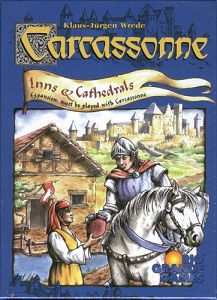
Carcassonne: Inns & Cathedrals (Die Erweiterung)
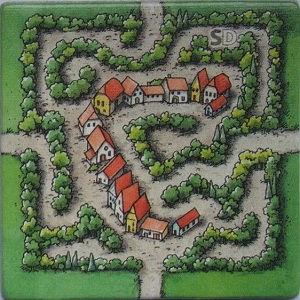
2002 / Tile placement board game expansion / 2-6 players / Germany****Carcassonne: The Labyrinth
2016 / Tile placement board game mini expansion / 2+ players / Germany
**Expansions don't come more mini than this: a fanciful way for one lucky player to connect four roads into one that helps to balance that underpowered feature in the base game and to menace grand infrastructure projects in larger expansions.
But let's face it, I bought it because it looks pretty and because a single-tile expansion is the cheapest path to indulgent satisfaction for the search-by-price-lowest-to-highest collector, even if their plan to flip a spare and make it even cheaper was neutralised by eBay fees.
I stopped buying myself biscuits and other unnecessary consumables when I started getting silly with expansions. These snacks are better for my teeth.
Brian Aldiss, A Kind of Artistry (1962) ***
Fascinating first contact collapses into Game of Thrones shite.
Philip K. Dick, Second Variety (1953) ***
I still haven't properly cracked open his short fiction, but this cautionary technofear parable didn't feel like the one you'd highlight for your anthology, outside of its ongoing prescience.
Keith Roberts, Weihnachtsabend (1972) **
Enough with Nazis already.
Robert Bloch, I Do Not Love Thee, Doctor Fell (1955) **
Lame satire building to an inevitable twist. Is this the best he's got?
Samuel R. Delany, Aye, & Gomorrah... (1967) **
I don't really get the New Wave.
Stanislaw Lem, How Erg the Self-Inducting Slew a Paleface (1977) ***
A welcome second helping of electro fairy tale nonsense.
Joanna Russ, Nobody's Home (1972) **
Disconcerting utopia.
Gérard Klein, Party Line (1973) ****
Life hands you an indecisive cheat mode.
Lewis Padgett, The Proud Robot (1943) ****
Adventures of a noir Dirk Gently and his vain can opener.
Henry Kuttner & C.L. Moore, Vintage Season (1946) ***
Connoisseur voyeurs.
Arkady & Boris Strugatsky, The Way to Amalteia (1984) ****
Humbled space survival. Let's just stay at home.
Terry Pratchett, The Rincewind Trilogy
Interesting Times (1994) ****
The first Rincewind book I've really enjoyed, and one of the better Discworlds generally, this might be down to Terry P's writing maturing, its take on Chinese alt-history and notions of civilisation and revolution being more interesting than the customary stock fantasy adventures, or even just the glut of puns.
In Praise of Darkness (1969) **
Ageing introspection. No fun at all.
Brodie's Report (1970) *
A conscious regression to the humdrum biographies of his earliest writing, because that's what we read Borges for. Labyrinths is all the abridged bibliography you need.
A. A. Milne, Best-Loved Winnie-the-Pooh Stories
Winnie-the-Pooh and Some Bees (1926) ****
A private story from father to son, made public to shame other parents into raising our game. Properly funny too, I should have been reading these instead of Noddy.
Pooh Goes Visiting and Pooh and Piglet Nearly Catch a Woozle (1926) ***
More logical, less substantial and down-to-earth vignettes after the flight of fancy, the animation adaptation is more notable for upsetting my toddler.
Piglet Meets a Heffalump (1926) ****
Infectious incompetent optimism.
Eeyore Has a Birthday (1926) **
A last-minute turnaround doesn't keep this from being generally depressing.
Kanga and Baby Roo Come to the Forest (1926) ***
A kidnapping farce is successfully executed, but the mother doesn't really mind.
An Expotition to the North Pole (1926) ****
Improv epic.
Piglet Is Entirely Surrounded by Water (1926) ****
Self-explanatory.
Christopher Robin Gives a Party (1926) ***
A sweet wrap-up.